

Key Takeaways
- Heavy duty fleet maintenance software structures, strengthens, and optimizes maintenance operations for heavy vehicle and equipment fleets.
- Cost control, reduced time waste, and better operational visibility are the main performance and differentiation levers.
- Automation and data centralization enhance overall shop performance and attractiveness for field teams, a key factor in today’s labor shortage context.
If you’re still using paper work orders or Excel spreadsheets to manage your shop, it’s probably time to go digital and differentiate yourself by controlling your costs and increasing your margins! Be better equipped to improve reliability and reduce maintenance costs for your fleet of heavy vehicles and equipment by choosing fleet maintenance management software.
Here are 10 concrete ways to leverage it.
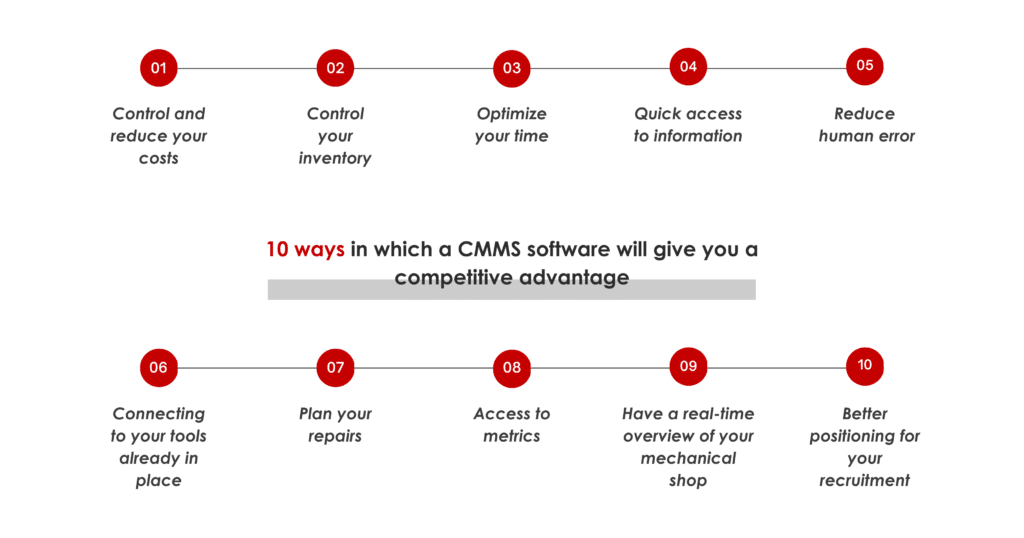
1. Control and Reduce Your Costs
The first thing heavy equipment maintenance software does to set you apart from competitors is give you better control over your expenses. The cost of parts, labor, and all other expenses are recorded in each work order and create a central database for all maintenance-related spending.
By running an expense report, the shop manager can see where the budget was spent and make strategic decisions about assets and future spending. By structuring preventive maintenance, problems are detected earlier, limiting major breakdowns and unplanned downtime.
When all information is in one place, processes are automated, and the manager can better observe operational costs, expenses are reduced and you can finally generate savings. By generating savings, you can increase your profit margin, achieve a return on investment (ROI), and invest in other areas of your business.
2. Better Manage Shop Inventory
Heavy duty fleet maintenance software lets you track your inventory in real time without using Excel files or endless lists. Thanks to automation, you no longer have to worry about running out of critical parts, as the software alerts the manager when it’s time to order through minimum and maximum thresholds.
By ordering parts in advance through the purchase order module, you save time and money by avoiding last-minute shipping fees. When a mechanic needs a part, they can request it directly from the shop floor. With good inventory management for heavy duty parts, your mechanics no longer wait for parts and your trucks get back on the road faster.
3. Optimize Team Time
When mechanics arrive for their shift, it’s important to know the workload so there are no overdue inspections or units waiting for repairs. Good software includes a module designed specifically for the shop floor, allowing mechanics to log in directly using an RFID chip and quickly access their daily tasks.
The manager no longer needs to create work orders in advance since they are automatically created when mechanics open a task. Using the integrated time clock, time is tracked automatically, reducing time lost to manual data entry. Teams focus on interventions, not administration..
4. Centralize Access to Information
A maintenance management system centralizes all data related to units, interventions, and operations. Repair history, inspections, and reports are accessible in just a few clicks. A search that used to take far too long flipping through disorganized filing cabinets now happens in seconds.
This centralization improves decision-making, enhances traceability, and speeds up responses to audits or internal requests.
5. Reduce Human Errors
Fleet maintenance management software lets you standardize your processes, improving performance and reducing errors by the maintenance team. By automating key steps, the software reduces data entry stages by eliminating manual tasks. This reduces the risk of human errors and ensures data quality.
Automated warranty and claims management also saves time: the system automatically creates claims and generates the form without any additional data entry, preventing costly oversights.
6. Integrate With Your Existing Tools
Make sure to choose heavy equipment maintenance software that can connect to your existing ecosystem to get the most out of each of your solutions. Proper integration lets you leverage the strengths of each tool and avoid double data entry.
For example, by connecting your telematics to your maintenance software, vehicle odometers are updated in real time in the system and preventive maintenance tasks are automatically created based on defined thresholds. MIR-RT is compatible with the vast majority of fuel, telematics, accounting, and dispatch solutions on the market.
7. Plan Maintenance Proactively
Maintenance planning relies on rigorous coordination of resources, priorities, and equipment availability. MIR-RT‘s planning module lets you see overdue and upcoming preventive maintenance, corrective notes, expiring warranties, and inspections to perform, then assign them to mechanics.
This reduces unplanned interruptions and keeps heavy vehicles and equipment in proper working condition. For more on this topic, read our article on how to better plan work in your shop.
8. Track Maintenance KPIs
Without reliable indicators, it’s difficult to improve shop performance. MIR-RT‘s dashboard offers over 100 reports and an interactive dashboard with maintenance KPIs related to costs, productivity, unit availability, and process efficiency.
This data helps evaluate results, adjust strategies, and improve the shop’s overall profitability. To learn more, read our article on the top 10 fleet maintenance KPIs.
9. Get a Real-Time View of Operations
Real-time visibility into shop activities allows better task distribution, bottleneck identification, and resource optimization. MIR-RT‘s real-time manager tracks time per intervention and work progress, improving planning and team productivity.
10. Attract and Retain Qualified Mechanics
It’s no secret that the labor shortage is increasingly felt across most industries. Candidates are looking for good working conditions and companies where they can grow.
By adopting heavy duty fleet maintenance software and automating your maintenance processes, you demonstrate a commitment to continuous improvement and technological advancement, which is attractive to the new generation of workers. Employees spend more time doing what they were hired for and less time at the computer or on paper entering data, which can be a major frustration for some.
Conclusion
The performance of a heavy vehicle and equipment shop relies on the ability to structure operations, strengthen data reliability, and coordinate teams effectively. Fleet maintenance management software is a concrete lever for improving cost control, reducing fleet downtime, and enhancing overall performance while providing a lasting competitive advantage.
Ready to Structure Your Shop Management?
Discover how MIR-RT can centralize your maintenance operations and help you stand out from the competition.