

Accounting integration between your maintenance software and accounting system can transform how fleet managers control costs. Here’s what you need to know before you dive in.
Key Takeaways
- The integration between fleet maintenance management software and an accounting system is a direct lever for operational efficiency.
- An accounting gateway eliminates double data entry, strengthens data reliability, and improves maintenance cost control.
- The value comes from synchronizing financial flows with field operations: work orders to accounts payable, automated inventory movements, and automatic general ledger account assignment.
- A well-structured integration facilitates decision-making and strengthens overall heavy fleet performance.
Fleet and heavy equipment managers are always looking for ways to increase shop efficiency while reducing costs. By understanding the importance of accounting in maintenance management, how integration with maintenance software works, the associated benefits, and the potential challenges that may arise, managers can ensure a successful implementation of their accounting gateway.
Why Accounting Is Central to Heavy-Duty Maintenance Management
Accounting is an essential element of heavy vehicle and equipment maintenance management. It enables tracking and recording of expenses and invoicing related to maintenance, while ensuring tight control over accounts receivable.
The price increases we’re experiencing are making life difficult across all industries, and mechanical maintenance is no exception. Fuel, tire maintenance, and parts costs are skyrocketing, and if you can better plan your budget through effective expense and revenue tracking, you’ll have a better chance of protecting your profit margins.
Fortunately, most maintenance software solutions like MIR-RT let you push maintenance costs directly to the accounting system through an accounting gateway, which includes a section for configuring general ledger account numbers. However, without this integration gateway, data is not synchronized with the accounting system and must be manually entered in both systems, which increases the administrative burden and multiplies the risk of errors.
How an Accounting Gateway Simplifies Operations
Using an accounting gateway with your heavy equipment maintenance software gives managers a more comprehensive view of their vehicles’ financial health. This integration makes expense and revenue accounting more accurate and easier to manage.
Without an accounting gateway, maintenance costs generated in MIR-RT must be manually re-entered into the accounting system, resulting in double data entry. Using this type of gateway becomes a golden opportunity to streamline operations and save tremendous time for accounting staff so they can focus on tasks that truly require human intervention.
Furthermore, accounting and maintenance management are often handled by different people, and consequently, communication and transcription errors are more likely to occur. Since accounting operations are often irreversible, avoiding such errors is particularly important.
Key Benefits of an Accounting Gateway
This type of integration offers much more than simple time savings for fleet managers and accounting staff.
Expense tracking and maintenance-related accounting information can be done in real time, whether from the original accounting system or the maintenance software. This means fleet managers can make better decisions about how to spend resources more effectively without having to request reports from the accounting team each time.
Eliminating double entry prevents many inadvertent numerical errors. It’s even possible to configure automatic error rules to control repetitive and easily identifiable accounting operations.
The capability of accounting gateways to push external work orders directly into accounts payable, or to replicate the chart of accounts process so the software detects the operation type and automatically assigns the correct general ledger account, should not be underestimated. It’s even possible to manage inventory movements automatically.
For multi-entity organizations, the integration consolidates financial data and provides a global view while maintaining detail by division or fleet.
Key Steps to Implement an Accounting Gateway
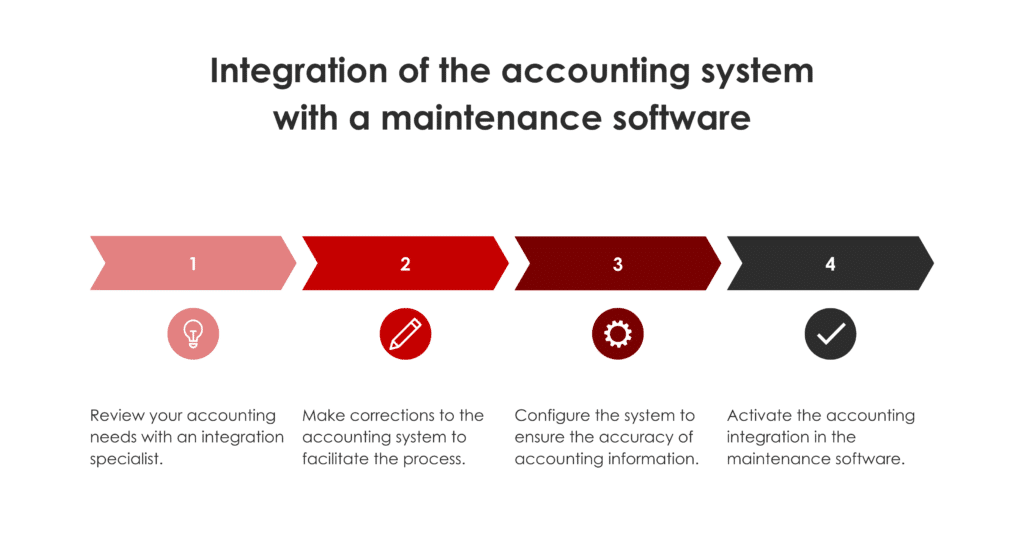
A successful integration relies on four structural steps.
1. Analyze needs: work with an integration specialist to identify the flows to automate and the adjustments required between the maintenance management system and the accounting system.
2. Correct the accounting structure: make necessary corrections, such as matching certain general ledger accounts so that operation code assignments work correctly.
3. Configure the system: ensure the accuracy of information exchanged between platforms and validate matching rules.
4. Activate the gateway: launch the data exchange between both systems, giving access to accounting reports directly from the shop.
Import Types: Batch or Automatic
When setting up the gateway, two import modes are available.
Batch import requires approval before completion, allowing data validation at each step. This is the recommended approach at the beginning of implementation to build confidence in the system.
Automatic import runs without intervention, offering additional time savings once the process is well mastered. A progressive transition between the two modes is a best practice to ensure data quality throughout the integration.
Data Security and Confidentiality
Data security is a fundamental element of any accounting integration. Financial and operational information must be protected by robust mechanisms, including data encryption and strict access management.
A secure integration helps meet regulatory requirements and ensures the confidentiality of sensitive information. Team training and adopting best practices help reduce risks and strengthen confidence in the system.
Common Challenges and How to Overcome Them
Some organizations face obstacles during implementation: no existing gateway, multiple accounting systems, or resistance to change from accounting teams.
These challenges can be overcome with a structured approach and adequate support. It’s important to remember that the gateway doesn’t eliminate the role of accounting staff: it transforms their work by replacing double entry with validation of synchronized data, a more reliable and less time-consuming task.
Best Practices for a Successful Integration
Validate compatibility between the fleet maintenance management software and the accounting system before starting. MIR-RT is compatible with the vast majority of accounting systems on the market, including Acomba, Sage, QuickBooks, and SAP.
Implement a progressive transition by starting with batch import before moving to full automation.
Streamline the account structure by reducing the number of accounts in the chart and relying on the maintenance software for operational detail.
Conclusion
Integrating an accounting gateway with your fleet maintenance management software connects field operations to financial data, eliminates redundant tasks, and enables more informed decisions. For heavy fleet managers, it’s a concrete lever for cost control and operational performance.
Want to Improve the Financial Control of Your Fleet?
Discover how MIR-RT and its built-in accounting gateway can simplify your daily maintenance operations and give you clear visibility into your costs.