

A year of structuring, automation, and connectivity.
The year 2025 marked a turning point for the transportation industry and the maintenance of heavy vehicles and equipment. In a context of persistent economic pressure, labor shortages, regulatory complexity, and accelerating technological change, many organizations were forced to rethink how they operate in order to maintain business continuity. In 2025, value came less from the tools themselves than from the ability to connect them effectively.
Rather than a year of disruption or ambitious technological promises, 2025 established itself as a year of operational realignment. The objective was not to predict everything, but to better structure, automate, and connect systems in order to reduce friction, improve data reliability, lower costs, and increase day-to-day efficiency.
The goal was not to predict every outcome, but to better structure, automate, and connect systems to reduce friction, improve information reliability, and gain operational efficiency.
Preventive maintenance structured around processes
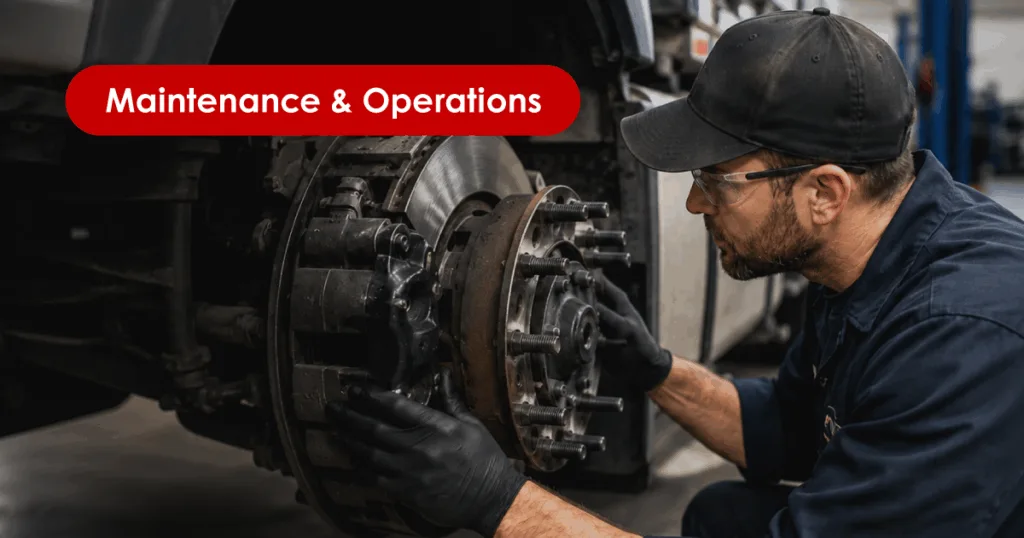
In 2025, preventive maintenance confirmed its role as an operational pillar for the most organized fleets. Organizations that continued to rely primarily on corrective maintenance faced costly unplanned downtime, increased pressure on their teams, and ongoing challenges in meeting schedules.
Conversely, companies that structured their preventive maintenance processes experienced improved asset availability and more stable control over operating costs.
This shift did not result in the systematic prediction of failures, but rather in better-organized maintenance activities: more coherent schedules, accessible maintenance histories, and clearer task prioritization.
Automation becomes a concrete operational lever
Faced with labor shortages and growing operational complexity, automation took on a central role in 2025. Organizations sought to reduce repetitive tasks and administrative workload in order to allow teams to focus on higher-value activities.
This translated into:
- Automated maintenance reminders and follow-ups
- More structured work order generation
- Improved coordination between maintenance and operations teams
The objective was never to remove human oversight, but to reduce operational friction and improve overall process flow.
System connectivity becomes a central challenge
In 2025, a clear reality emerged across many organizations: even the most powerful tool delivers limited value when it operates in isolation. The limitations of siloed systems, maintenance, accounting, dispatch, telematics, fuel management, parts management, trailer or asset tracking, and ERP became increasingly evident.
The limitations of isolated systems
The most structured fleets began shifting toward stronger system connectivity to reduce duplicate data entry, improve data reliability, and enhance information flow across teams.
Building bridges between key systems
This interconnection enables, among other things:
- More effective synchronization between operations and maintenance
- A more coherent link between maintenance activities and actual costs
- Improved visibility into asset utilization, availability, and condition
By connecting maintenance tools with telematics, fuel management, parts management, dispatch, asset tracking, and accounting or ERP systems, organizations began building workflows that are more fluid, more coherent, and less dependent on manual intervention.
Data centralization as an operational foundation
This increased connectivity highlighted the importance of data centralization. In 2025, the limitations of spreadsheets, paper notes, and disconnected tools became increasingly difficult to ignore, particularly when it came to traceability and timely decision-making.
Organizations that centralized their data benefited from:
- Better visibility into the true state of their fleets
- More reliable performance indicators
- Fewer errors caused by manual data entry
In this context, data was not yet used to automatically predict failures, but rather to stabilize daily operations and support more informed decisions.
Artificial intelligence as team support
While artificial intelligence continued to attract significant attention in 2025, its adoption remained pragmatic. For most organizations, AI was primarily used as a support tool rather than as an autonomous decision-maker.
The most concrete use cases included:
- Detecting anomalies or unusual patterns
- Assisting with maintenance prioritization
- Automating certain repetitive tasks
In a context of labor shortages and knowledge transfer, these tools helped ensure better operational continuity by leveraging existing data rather than relying solely on individual experience.
Economic pressure and the pursuit of resilience
Throughout 2025, transportation companies faced higher costs, increasing safety and compliance requirements, and constant pressure to meet delivery timelines.
In this environment, profitability no longer came primarily from expanding operations, but from improving operational efficiency. The most resilient fleets were those that succeeded in better connecting their systems, automating key tasks, and turning available information into concrete actions.
Technology thus became a tool for operational stability and continuity, rather than simply an innovation initiative.
Conclusion: 2025, the year of connected foundations
For most of the industry, 2025 was not the year of advanced predictive maintenance. Instead, it marked the establishment of essential foundations: more structured processes, automated tasks, and increasingly interconnected systems.
Before effective prediction could become a reality, the industry first needed to learn how to execute more precisely, document more consistently, and ensure better information flow. These foundations now set the stage for the next phase, where advanced automation and smarter data utilization will gradually take over.